
 Md Sarwar


Google’s latest Gemini model is putting the spotlight on something developers increasingly care about: getting AI to complete tasks efficiently, not just answer complicated questions.
Gemini 4 Hydrogen is designed around speed, coding and agent-based workflows. Rather than positioning it purely as another model for advanced reasoning, Google is focusing on practical tasks such as writing code, fixing errors, testing applications and helping AI agents work through development processes.
The approach reflects a broader change in AI development. As businesses move beyond simple chatbots and start building AI-powered applications, the ability to execute tasks reliably is becoming just as important as the ability to generate intelligent responses.
A different approach to AI model development
Not every software development task requires the most powerful AI model available. Writing a small function, fixing a syntax error or updating an existing component generally does not require the same level of reasoning as designing an entire software architecture.
This is where Gemini 4 Hydrogen is intended to fit.
Google is positioning the model for repeated development tasks where response speed and execution efficiency matter. Developers can use it for coding assistance, debugging, repository-level changes and workflows involving multiple AI agents.
The model also offers configurable thinking levels, allowing developers to balance reasoning depth against speed and resource consumption.
For smaller development teams, this could be particularly useful. Instead of sending every request to an expensive, high-capability model, developers could delegate routine implementation work to a more efficient model.
Early benchmark results show potential
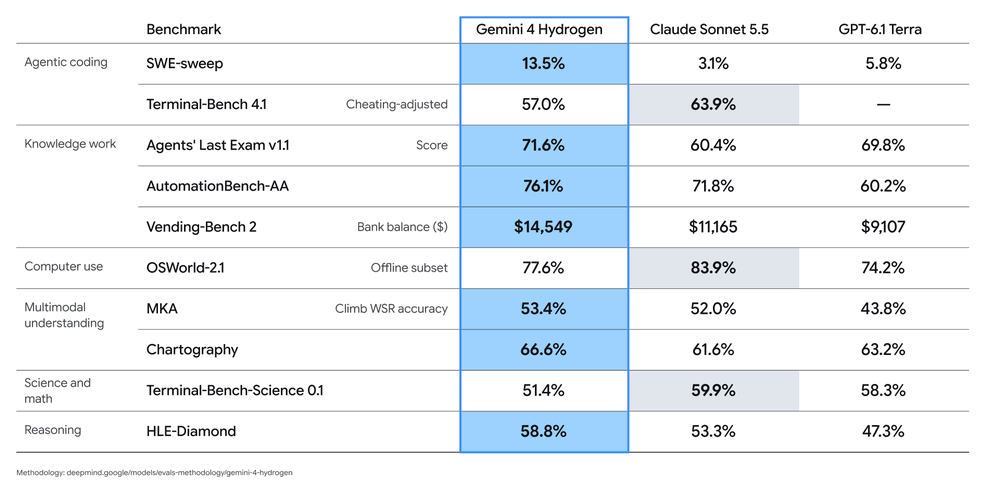
Performance benchmarks will play an important role in determining whether Gemini 4 Hydrogen can deliver on its promises.
According to the benchmark results discussed in the initial reports, Hydrogen recorded a 51.1% task completion rate on Zapier’s AutomationBench evaluation at high thinking effort. Gemini 4 Argon reportedly achieved 51.3%, while Gemini 4 Carbon reached 53.9%.
The interesting part is the estimated cost difference. Hydrogen reportedly completed these tasks at a lower cost than the other two models.
However, benchmark results need context. AutomationBench evaluates business workflow tasks using simulated applications. Its results do not necessarily reflect how the model performs when working with real production software, complex repositories or unpredictable user environments.
Independent coding tests and longer-term developer feedback will provide a clearer picture of its practical capabilities.
Why Google’s multi-model strategy matters
Perhaps the more interesting development is how Google intends to use Hydrogen alongside its other Gemini models.
The traditional approach to AI development often involves selecting one model and using it for almost everything. Google’s multi-model strategy points towards a more specialised system in which different models handle different responsibilities.
For example, a more capable reasoning model could plan a software project, identify architectural problems and divide work into smaller tasks. Gemini 4 Hydrogen could then handle implementation, testing and routine code modifications.
This approach could make AI development workflows more efficient, particularly when multiple agents are working on different parts of a project.
Google’s reported Orchestrator improvements also suggest that coordinating models intelligently could be as important as improving the capabilities of individual models.
What developers should know about availability and pricing
Google’s developer ecosystem is an important part of Hydrogen’s potential adoption.
The model’s reported availability across Google AI Studio, the Gemini API and supported development products could make it easier for developers to experiment with it without building an entirely new infrastructure.
The previously reported API pricing is $1.50 per million input tokens and $7.50 per million output tokens.
For developers building AI-powered applications, token pricing is only one part of the equation. Response quality, task completion rates, latency and the number of retries required can all influence the actual cost of running an application.
A cheaper model is not necessarily the better choice if it requires significantly more attempts to complete a task.
What this could mean for AI-powered software development
Gemini 4 Hydrogen highlights an increasingly important direction in the AI industry: specialised models designed to work together.
For independent developers, this could mean more affordable coding assistance and automation. Businesses could potentially use different models for planning, implementation, verification and repetitive operational tasks.
However, developers should not rush to replace their existing AI infrastructure based on early benchmark results alone.
Real-world testing will be necessary to understand how Hydrogen handles large codebases, debugging sessions, complex instructions and tasks that require several tools to work together.
The bigger picture
The competition between AI companies is no longer just about which model performs best on a reasoning benchmark. Cost, speed, reliability and the ability to complete multi-step tasks are becoming equally important.
Gemini 4 Hydrogen represents Google’s reported effort to address that shift.
Its long-term value will depend on whether developers can consistently use it to complete practical work at a lower cost without sacrificing reliability.
For now, the most important thing to watch is not simply its benchmark score, but how well it performs when developers put it to work on real projects.
Official sources and further reading:
- Google Gemini announcement: https://blog.google/innovation-and-ai/models-and-research/gemini-models/introducing-gemini-4-hydrogen/
- Google DeepMind model documentation: https://deepmind.google/models/model-cards/gemini-4-hydrogen/
- Google Developers documentation: https://blog.google/innovation-and-ai/technology/developers-tools/build-with-gemini-4-hydrogen/
